Guide to New York Divorce Records
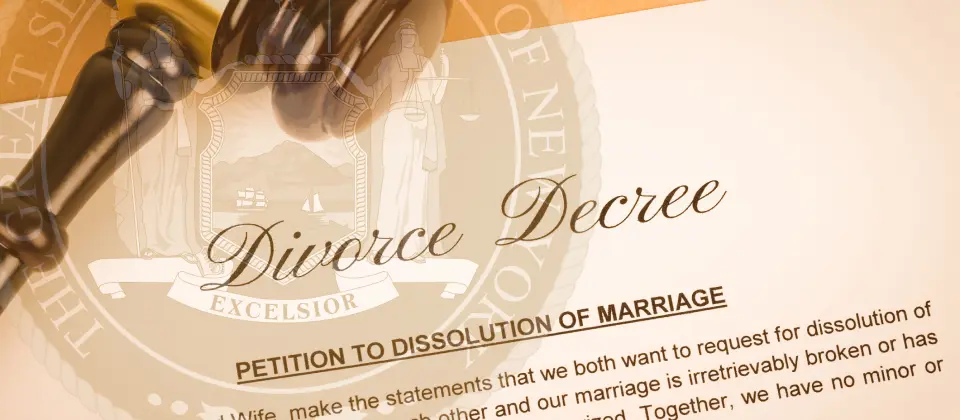
The divorce process and document availability vary significantly by state. In New York, divorce cases are handled by the State Supreme Court, which presides over the state's most significant civil cases, including dissolving a couple's marriage.
The process for obtaining a divorce typically begins when one spouse files a Summons With Notice or a Summons and Complaint in the New York State Supreme Court in the county where either spouse resides. As the divorce case progresses, the court will collect documents, including filings, motions, and orders, and maintain an official case file accessible to both parties.
Once a couple has completed the divorce process, the court generates formal documents that signify the termination of the marriage. These documents collectively form the divorce record, which will ultimately be used for future legal, administrative, or individual record-keeping purposes.
Divorce court documents contain many important pieces of information, including:
The names of both parties to the divorce
The name of the county and the Supreme Court in which the divorce action was filed
The index or case number that was assigned to the divorce
The date when the divorce judgment was entered
Court orders regarding custody of children, parenting rights/parenting time, and how property will be divided
Whether the divorce case was contested/uncontested
Divorce records are generally kept by the county clerk's office in the county in which the divorce took place. A divorce record summary is also available through the State Vital Records Office. Older divorce records may be filed in paper archives, while newer divorce records may be electronic filings within the court system.
Knowing how divorce works in New York and how records are created can make it easier to find the documents you might need later.
Where are New York Divorce Records Stored?

In New York, divorces are documented at two levels: county and state, based upon what type of information you need.
At the county level, all divorce cases in New York are processed through the Supreme Court, which serves as the trial court for all civil matters. All divorces in New York State are filed and finalized in the Supreme Court of the county in which one or both spouses reside. The County Clerk's Office maintains all official case files from each divorce, which include a copy of the full divorce decree, petitions, motions, and all applicable court orders.
The New York State Department of Health, Division of Vital Records, maintains a statewide divorce index for all divorces filed throughout New York State. These indexes are produced through submissions to the NYS DOH by the Clerks of the Supreme Court Offices after a divorce has been finalized. The statewide divorce index can serve as an official document confirming that a divorce occurred and summarizing key information about it.
Divorce records are also stored in physical or electronic format.
Physical records are old case files that may exist only as paper documents in the County or Borough Clerk's office archives where the divorce was granted. They can generally only be reviewed at the county or borough Clerk's Office where the divorce was granted.
Digitally stored divorce records have become more common for recent divorces. The majority of counties now have electronic filings of all divorces recorded within the county.
Is New York a 50/50 Divorce State?
No, New York is not a “strict” 50/50 divorce state. Instead, it is an “equitable distribution” state; that means the court will divide marital property, property acquired together, as they consider fair to both parties, not necessarily 50/50.
Under New York State Law, judges have discretion to divide property based on the facts of each case and the parties' respective positions. Therefore, a judge could determine a fairly equal division of property; however, a judge could also award a greater portion to one party when the court believes that is the fair decision.
New York Domestic Relations Law§ 236 outlines the legal basis for how courts evaluate the parties' property and financial interests at the time of dissolution.
In determining how to equitably distribute marital assets/debts, New York courts will consider multiple factors to ensure fairness.
Duration of Marriage: In longer marriages, the court splits the couple's assets fairly (equitable distribution) because they will likely view the couple as having a shared financial history. In short marriages, the court tends to place greater emphasis on what each spouse brought into the marriage.
Contributions of Each Spouse: New York courts will also examine the financial and non-financial contributions each spouse made during the marriage.
Income and Earning Capacity: In New York courts will take into account your present income and ability to generate income in the future, especially when one spouse earns significantly more than the other and/or has a stronger career outlook than the other spouse.
Marital vs. Separate Property: In New York, marital property, which generally includes all the assets and liabilities acquired during the marriage, such as real estate, retirement accounts, etc., or income earned during the marriage, will be subject to division. Separate property, such as property acquired prior to the marriage, gifts received from others, or inheritances, normally remains the separate property of that party.
Fault Factors: New York primarily follows a “no fault” policy, where couples may obtain a divorce based on the fact that the marriage has broken down. However, serious misconduct may be a consideration of the courts when making financial determinations in divorce matters.
Types of New York Divorce Records

When a divorce is finalized in New York, the formal process produces two types of documents. Each of these documents will serve a different purpose; one simply confirms that the couple is divorced, while the other includes all the details of how the court reached its final decision.
New York Divorce Certificate (Certificate of Divorce)
A divorce certificate, sometimes called a Certificate of Dissolution of Marriage, is a simple document that states a divorce is finalized in New York State. The document is issued by the New York State Department of Health and will include basic information, such as the couple's names, the county where the divorce was granted, and the date the divorce became final.
The divorce certificate is most commonly used to provide proof of marital status for remarrying or updating records. A divorce certificate is only a summary of the divorce and does not contain the specific details outlined in the divorce decree. Thus, the divorce certificate cannot be used as a divorce decree.
Divorce Decree (Final Judgment of Divorce)
The Final Judgment of Divorce, also known as a New York divorce decree, is the most formal document in a divorce. These are the court's formal orders that end the marriage and outline the decisions made during the divorce. The final judgment makes the decree legally binding on both parties involved.
Typically, the divorce decree outlines many of the key rulings made by the court, including:
Property and Debt Division: The divorce decree should outline how marital property (assets) and debts will be divided between the parties.
Spousal Support /Alimony: If the court grants spousal support, the type, amount, duration of support, as well as other details regarding alimony, should be included in the divorce decree.
Child Custody and Support: The court's child support and custody terms will be outlined in detail in this section of the divorce decree.
Final Judgment Date: This is the official date the judge signs the divorce decree, which is also the date the marriage was terminated.
It includes the complete legal details of the dissolution of the marriage; the divorce decree is typically required to enforce a court order, modify child support or custody, resolve post-divorce disputes, or otherwise enforce a court order.
How to File for Divorce in New York (Step-by-Step)
The divorce process in New York typically consists of specific legal steps that may vary by case. However, there is a general framework for how you can file for divorce from the day you file the first papers until the court issues the final judgment of divorce.
To file for divorce in New York, at least one spouse must meet the state's jurisdictional requirements (residency). These rules determine whether or not the New York courts will have the authority to consider your case.
Per New York Domestic Relations Law §230, you may file for divorce in New York if either of the following two conditions exists:
The couple was living in the State of New York at the time the divorce petition was filed, and the cause of their divorce arose within the State of New York.
The couple lived together as husband and wife in the State of New York prior to the filing of the divorce petition, and at least one spouse resided in the state continuously for one (1) year prior to the filing.
At least one spouse had been residing in the State of New York for two (2) consecutive years preceding the commencement of this action.
Before filing for divorce, you should know whether it will be uncontested or contested, as this will influence the steps you take and the timeline.
An uncontested divorce means there are no disagreements between the two parties regarding the major issues before filing for divorce. Major issues usually include child support, how marital assets, debts, and other financial responsibilities will be divided. It also includes spousal support, and how children will be placed in the care of which parent, and what type of visitation will occur.
An uncontested divorce is usually less costly than a contested divorce because it requires fewer trips to the courthouse. Also, since neither party is contesting anything, there is nothing for the judge to rule on, making an uncontested divorce faster. In addition to the cost savings, you'll have more control in the final decision regarding property division and child custody arrangements.
When a couple cannot agree on at least one of the major issues typically decided in a divorce, such as dividing assets, paying off debt, or determining child custody, this is called a contested divorce. Therefore, a contested divorce is more complicated and may require additional legal processes than an uncontested divorce.
Contested divorces typically take longer than uncontested divorces because the court must consider all evidence submitted by each party and make a fair decision on the disputed issues.
When a couple files for a contested divorce, both spouses have less control over how property will be divided, how debts will be paid, or who will have custody of their children. In addition, the judge's decision will be final regardless of whether either spouse agrees with it.
Lastly, to obtain a divorce in New York, you will also need to establish “grounds”, meaning an acceptable reason for ending your marriage that is accepted by the law. You will provide a statement in the court papers filed that states a valid basis for divorce, such as adultery, abandonment, or cruel treatment. More often than not, couples file for divorce based upon a “no-fault” ground for divorce, which simply indicates the marriage is irreparably damaged and therefore ended.
Step-by-Step Divorce Process
When filing for divorce in New York, there can be slight variations depending on which county or borough you are filing in, which of the no-fault divorce grounds you choose, and if your divorce is contested or uncontested. However, the overall process for filing for divorce across New York follows this path.
Prepare the Filing Packet
Before opening a New York divorce case, you need to have all the required paperwork from the Supreme Court ready and organized. Accuracy and completeness are essential at this time, as this stage establishes your case and has an impact on how well your case is prepared.
During this time, you should:
Identify the Divorce Path (1A vs. 1B): Determine whether your divorce going to be contested or uncontested.
Prepare the Required Documents: Gather all relevant documents, including:
The Summons with Notice or Summons and Complaint Document: These documents formally begin the divorce process. It provides notice to the opposing spouse that a divorce case has been initiated and lists the general bases for divorce.
The Verified Complaint for Divorce: In cases where the summons and complaint are used, this form details the legal reason(s) for divorce and the relief being sought from the court, i.e., custody, distribution of marital property, etc.
Separate Agreement (in an Uncontested Case): When the parties have already settled all issues before commencing the divorce process, they may submit a signed, separate settlement agreement using this form.
Statement of Net Worth: It is a court-ordered document that requires you to detail each item of your financial information - income, expenses, assets, property, and debt.
Use this filing packet if your divorce is uncontested, and this packet if your divorce is contested.
Filing Fees and Fee Waivers: When filing the divorce paperwork, the court will charge you at least $335 in filing fees in order to file your uncontested divorce, and that is based on two different filing fees: the Index Number filing fee of $210, and the second filing fee being the Note of Issue filing fee of $125. If you cannot afford these filing fees, you can submit a request to waive them. This is sometimes referred to as “poor person relief” or an “indigency application.” If the court approves your waiver, you may be able to complete the divorce without paying some of the filing fees.
File the Case
After you have prepared your divorce filing package, the next step is to file your divorce with the court. This is the formal action that starts your divorce and enables the court to follow your case.
Where to File: Divorce filings in New York are filed with the Supreme Court of the State of New York in the county in which one spouse resides.
Filing Methods: New York has three different methods by which to file a divorce:
In Person: You may personally present your completed filing package to the County Clerk's Office.
By Mail: If you are unable to appear at the courthouse in person, you may send your completed filing package by mail, along with the required filing fee(s) or a request for a fee waiver. Please include a self-addressed, stamped envelope if you would like the court to send you copies or notice of any proceedings.
Electronic Filing (eFiling): Some counties in New York permit electronic filing of divorce actions. Check with the County Clerk's Office to determine whether the court accepts electronic filings and what specific procedures must be followed to utilize this method.
What You Receive: Once you have your case file, the court will provide the documents below confirming your divorce case is underway.
Case Number: This unique number tracks all activity in your divorce case, including filings, motions, and court orders.
Summons: In a contested divorce case, the court issues a summons to inform the other spouse of the case and of their requirements to respond.
Initial Court Notice: The court may also send or provide you with information and/or instructions regarding filing deadlines, necessary forms, and future steps in the divorce process, i.e., preliminary hearings/conferences.
Service of Process (Primarily for Contested Cases)
If one spouse files for a contested divorce in New York, they must notify the other spouse of the filing. This notification is referred to as service of process and can take many forms, including:
The Sheriff
A professional process server
Certified mail
Once the spouse has been formally served, the spouse who was served will be required to submit to the court evidence of service (proof of service) to demonstrate that formal service has occurred.
When it is difficult to locate a spouse, courts permit alternative methods of service. These alternatives may include publication of the notice in a local newspaper or mailing the divorce documents to the spouse's last known address.
Early Case Phase and Temporary Orders
During the initial stages of the divorce process, courts seek to establish and maintain a status quo with respect to child-related matters. This stage of the divorce process generally involves gathering information through discovery.
After the parties have had time to gather all necessary information, a court may issue a temporary order to stabilize the situation and address urgent issues, such as parenting time, division of assets, or other immediate financial matters. The purpose of these temporary orders is to create stability and fairness in your divorce case, especially when the parties cannot agree on important issues.
The Judge can also have a hearing after mediation to decide whether to grant the following temporary orders:
Temporary Custody and Visitation: This order determines which parent the children will reside with during this period of the divorce proceeding, and how much time the other parent will be allowed to spend with the children.
Temporary Child or Spousal Support: The purpose of this order is to provide for the basic needs of the children, and/or provide temporary support to enable the lower-earning party to continue to meet their living expenses until the divorce is finalized.
Exclusive Use of Marital Property: This order allows one spouse to remain in the marital residence until the divorce is finalized.
A Protective or Restraining Order: When there is concern about harassment or threats by a spouse, the court may issue either a protective order or a restraining order that limits a spouse's ability to have contact with the other spouse.
Financial Disclosures and Discovery
Once a divorce proceeding is filed and is moving through the New York court system, both spouses are required to exchange financial information with one another and with the court. This stage of the proceeding is called financial discovery and disclosure. The primary goal of the process is to make all aspects of the spouse's finances clear so the court has sufficient information to make fair and equitable decisions.
Mandatory Disclosures: New York requires both spouses to complete the “Statement of Net Worth.” This document lists each spouse's income, expenses, assets, and debts and helps the court determine each party's financial status when making divorce-related decisions.
Supporting Documents: Additionally, the court may request supporting documentation from each spouse to support the information listed on the “Statement of Net Worth.” Supporting documentation could be tax returns, pay stubs, bank statements, credit card statements, loan documents, etc., and retirement account statements.
Discovery Tools: Legal Discovery tools are used when a couple has disputes over money or property, and both parties need to know what each party owns or has borrowed. Discovery tools that are available to couples include:
Document Request: Document requests allow either spouse to ask for copies of the other spouse's financial records, such as loan papers, tax returns, business contracts, property deeds, etc.
Interrogatories: One spouse sends written questions to the other, which the responding spouse must answer under oath.
Subpoenas: A judge orders third parties, such as banks, employers, and financial institutions, to provide financial documents and/or records related to the dispute.
Depositions: Depositions occur when a spouse or witness is asked questions under oath outside the courtroom.
Case Management and Court Conferences
In New York divorces, courts use case management conferences to help organize the divorce process. Case management conferences allow the court to monitor a case's progress, establish timeframes for completing tasks, and promote settlement negotiations so that a trial need not occur. The purpose of these conferences is to save the parties time, money, and stress in resolving their divorce as quickly as possible.
A pre-trial conference may also be held at some point before trial. During a pre-trial conference, the judge will review any outstanding issues regarding custody, property, or spousal support. Additionally, the judge will confirm all necessary information regarding the upcoming trial, including witness lists, the introduction of evidence, and procedural rules.
These conferences enable the court to have control over how the divorce is managed and provide the parties with an understanding of what they are expected to do prior to going to trial.
Settlement or Trial
Settlement and trial are two possible ways to resolve a divorce in New York. In most cases, the court encourages spouses to settle disputes whenever possible because it is usually faster, less costly, and less stressful than going to trial. If you are considering settling your divorce case, there are many options for you, including.
Formal negotiations between you and your spouse to reach an agreement regarding property, custody, and support issues.
Negotiations assisted by a mediator, a neutral third person who can facilitate communication and help you reach an agreement.
Negotiations led by both spouses' attorneys.
However, if the parties cannot reach an agreement regarding major concerns, a trial is required. At this point, you would be working very closely with your attorney to present your side of the case to the judge at trial.
Both parties present evidence and call witnesses to support their positions by providing documentation, financial data, and testimony.
Each party may also submit proposed findings of fact and proposed judgments/orders that they wish the court to enter.
The judge will make final rulings on all issues not agreed upon by the parties, including the equitable distribution of marital assets, custody arrangements, and the amount of support to be paid by one or both parties.
Judgment, Waiting Periods, and Finalization
In New York, there is no waiting period before an individual can finalize their divorce after they file. This timeframe will depend on many factors, including how contentious (and therefore complicated) the case is and how efficiently the parties complete the necessary documentation.
Cases that are uncontested, that is, both spouses agree on all issues, can move through the process very quickly, once the court has reviewed the documentation. Contested cases generally take much longer. This is because they usually require each spouse to provide discovery, attend court conferences, and sometimes even appear at trial before the judge makes a final decision on all issues in dispute.
New York also does not require a waiting period before remarriage following a divorce. Once your divorce has become “final,” you will be able to marry again immediately. Your divorce is considered final in New York when the final judgment of divorce has been signed by the judge and entered into the court record by the County Clerk.
Child Custody and Child Support in New York Divorces
In cases where divorcing parents have minor children residing in New York State, the court must determine who will care for the children and who will be responsible for providing financial support.
The court's determination regarding the children's care and financial support is made using the “best interest” standard for the child. In this context, “best interest” refers to the arrangement for the child that provides the greatest safety, stability, and opportunity for healthy growth and development, rather than the parents' preferences.
In determining what is in the best interest of the child, the court will evaluate the following:
The quality of the relationship of the child with each parent.
Each parent's ability to establish or maintain a stable home environment for the child.
Each parent's ability to meet the child's physical and emotional needs.
The degree of cooperation demonstrated by each parent in facilitating the child's relationship with the other parent.
If the child is sufficiently mature to express a preference, the child's preference will also be considered.
All determinations regarding the care of the children and their financial support are governed by New York Domestic Relations Law §240, which directs Courts to give priority to the welfare of the children in all matters relating to the disposition of custody and support rights.
Legal Custody vs. Physical Custody
In New York, child custody is generally categorized into two types: legal and physical custody.
Legal Custody refers to the authority to make important decisions regarding a child's health, education, and religious upbringing; it can be shared (both parents) or sole (one parent).
Physical Custody refers to where the child will live on an ongoing basis. In many cases, a child will reside with one parent (primary physical custody) but will still have regular visitations with the other parent. However, there are also many cases in which both parents have equal rights to physical custody (joint), and the children divide their time between their homes.
New York courts typically encourage arrangements that allow children to maintain meaningful relationships with both parents whenever it is safe and appropriate.
Child Support Guidelines and Enforcement
New York uses standardized child support guidelines to determine how much financial assistance a parent must provide for a child after divorce. These guidelines are part of New York State's Child Support Standards Act, which establishes formulas based on both parents' income and the number of children each has.
Generally, the non-custodial parent is required to pay child support to help cover the expenses of housing, food, clothing, health care, and the child's education. If special circumstances exist, the court may modify the guideline amount.
If a parent fails to pay child support, the state can use several enforcement methods to ensure compliance. These include:
Wage garnishment
Interception of tax refunds
Suspension of driver's or professional licenses
Court enforcement action
Property, Debt, and Alimony in New York Divorces
When couples get divorced in New York, a judge must determine how to divide their assets, liabilities, and financial obligations. The purpose of these determinations is to create a fair separation of each spouse's financial situation and to help both spouses transition into their new life outside of marriage.
A crucial first step for divorcing couples in New York is determining which assets are marital and which are separate.
Marital property generally includes all money, homes, retirement accounts, cars, and other property acquired during the marriage, regardless of whose name is on the items. Generally, the court will divide these types of assets.
Separate property, on the other hand, is typically owned exclusively by either one of the spouses and does not get divided as a result of the divorce. Separate property may include property that was purchased prior to the parties' marriage, inheritances, and gifts made to one party from another person, etc.
However, a New York Judge could potentially divide an item of separate property if it is mixed with marital assets or transmuted into an item of marital property, rendering it impossible to distinguish. For example, if inherited money is deposited into a joint account or used to improve a shared home, the court may need to determine whether some or all of that property should be treated as marital.
The process of dividing marital debts is similar to the division of other marital assets. In general, any debts incurred by either or both parties during their marriage are considered “marital” debts. The courts will decide how those debts, including mortgage payments, car loan payments, credit card balances, medical bills, etc., will be divided among the spouses.
In making this decision, the judge will look at several key factors, including:
Each spouse's financial situation as it relates to paying off the debt
Who actually incurred the debt, and why
Did the debt benefit just one spouse, or did it benefit both spouses
The total distribution of all the other marital assets
In addition, some New York divorces will have a judge order spousal support (alimony), so that one spouse can maintain financial stability when the marriage ends. Spousal support is typically ordered by the court as follows:
Periodic Alimony - Regular, monthly payments over a specific time frame to support the receiving spouse from the date of separation until remarriage or death of either party, whichever first occurs.
Rehabilitative Alimony - support provided to a spouse who is attempting to become self-sufficient. Rehabilitative alimony is most commonly ordered during the time a spouse is completing his or her education, vocational training, or otherwise preparing to enter the work force again.
Lump-Sum Alimony - A single payment, which settles the obligation for spousal support in its entirety.
Errors, Omissions, and Corrections in New York Divorce Records
Typically, errors found in divorce records include misspelled names, incorrect dates, omitted important information, or clerical errors during the preparation of files or records. If these mistakes are not corrected, they can cause problems with using the document for legal, administrative, or personal purposes.
The first step in fixing these errors is to contact the Supreme Court or the New York State Department of Health, depending on the type of document, to request changes to the record. Typically, this requires you to submit your request along with documentation that confirms the correct information.
To amend a clerical error contained in a divorce decree or final judgment, you would typically have to file an official motion with the court requesting that the document be modified. Clerical errors, such as misspellings, are relatively easy to correct; however, when it comes to errors that could affect major terms within a decree, you will require judicial approval to make any changes.
Once your corrections or amendments have been approved, you can get updated certified copies of the records.
Updated certified divorce certificates will come from the New York Dept of Health
Updated certified decrees will come from the County Clerk's Office that granted the divorce.
How to Access New York Divorce Records
You can request a divorce record in New York in different ways depending on whether you need a divorce certificate or the full divorce decree.
Online
Divorce Certificate (or Certified Copy of Divorce): If you wish to order your divorce certificate online, you can do so by using VitalChek. Make your payment for the certified copy of your divorce online. Your document will be mailed to you once they receive your payment and verify your identity with the state of New York.
Divorce Decree: A divorce decree is generally not available online; you will need to contact the clerk's office at the county courthouse where your divorce was granted in order to obtain your divorce decree.
In Person
Divorce Certificate: If you need it immediately, go to the health department in the county where the divorce was granted. They can issue one to you the same day.
Divorce Decree: Go to the clerk's office at the Supreme Court in the county where your divorce was finalized. To view your divorce decree, you will have to bring identification and the required documents with you.
Divorce Certificate: Fill out the state-issued request form for your divorce certificate and send it along with the required fee, a self-addressed, stamped envelope, and your photo ID to the NYS Department of Health.
Divorce Decree: Fill out a written request to the clerk's office at the Supreme Court where your divorce was finalized. The information you will need to include is as follows: your name, your spouse's name, the date of divorce, the case # (if known), contact information, and the required certification fee.
New York Courthouses That Handle Divorces
It is important to understand where to file a divorce, which court has jurisdiction over divorce cases, and where to search for an Alabama divorce record.
Court Authority for New York Divorce Cases
Only the Supreme Court in each county has the power to hear divorce cases, make decisions regarding custody, child support, alimony, and property distribution, and enter the final judgment of divorce. This is the only court that can issue a legally binding divorce decree in New York.
County-Based Filing
Divorces are filed with the county where one or both spouses reside. If you live in Albany County, for example, your divorce must be filed with the Albany County Supreme Court. In this way, you ensure that the court has jurisdiction (the power) to address your divorce case.
Some other examples of counties' Supreme Courts handling divorce are:
New York County Supreme Court - serves Manhattan
Kings County Supreme Court - serves Brooklyn
Queens County Supreme Court - serves Queens
Bronx County Supreme Court - serves the Bronx
Richmond County Supreme Court - serves Staten Island
Jurisdiction Basics
The Supreme Court is the only court within the counties of New York with jurisdiction to grant divorces and render legally binding divorce decrees. Therefore, other courts, such as circuit courts, probate courts, family courts, and/or municipal courts, do not have jurisdiction over divorce proceedings and cannot finalize a dissolution of marriage.
Although the Supreme Court has statewide jurisdiction over divorce matters, filings are processed at the local level by the county court in which either party resides; the filing court oversees all aspects of the case.
Examples of the New York Supreme Courts
Each New York County has at least one Supreme Court, which hears and keeps records of divorce cases. Some examples include:
New York County Supreme Court (New York County, Manhattan)
Kings County Supreme Court (Kings County, Brooklyn)
Queens County Supreme Court (Queens County, Queens)
Bronx County Supreme Court (Bronx County, Bronx)
Richmond County Supreme Court (Richmond County, Staten Island)
Westchester County Supreme Court (Westchester County, White Plains)
Role of the Supreme Court Clerk
The Supreme Court Clerk is responsible for processing all paperwork (filing) with the Supreme Court. Once you have filed your divorce, the Supreme Court Clerk's Office will:
Accept your divorce filing packet and associated fees.
Issue a case number for your divorce.
Maintain the Official Divorce Decree and related filing documents.
Provide Certified Copies of the Decree upon Request.
FAQ
Are divorce records public in New York?
New York divorce records are partially available to the public. The divorced couple, each other's attorney, and/or an authorized person may obtain a copy of the divorce certificate. Copies of the full divorce decree (Final Judgment of Divorce), however, remain in the court's possession and are generally released only with proof of identification and/or an approved reason for release.
What is the difference between a certificate and a decree?
The divorce certificate is a brief document that confirms a person has been granted a divorce and includes information such as names, the county where it was granted, and the date. The final judgment of divorce (divorce decree) is the complete document detailing all court rulings, including property division, custody, and support.
Do I need to know the county?
Yes. The divorce record (both certificate and decree) is tied to the county where the divorce was granted. Therefore, knowing the correct county will help you direct your request to the appropriate office.
How far back do records go?
New York state divorce records vary from one county to another. Some counties may have divorce records dating back many years in paper-filed archives, while newer cases will be stored electronically.
How much does it cost?
Fees vary depending on the type of record and how it is requested. Divorce certificates may have separate copying and certification fees, which are set by the County Clerk. Generally, certified copies of a divorce certificate cost $3 from the State Department of Health.
Can I Search New York Divorce Records for Free?
While you can view basic court information related to divorce records at the courthouse for free, the complete divorce records, especially divorce decrees, are not free.
Table of Contents
- Where are New York Divorce Records Stored?
- Is New York a 50/50 Divorce State?
- Types of New York Divorce Records
- How to File for Divorce in New York (Step-by-Step)
- Step-by-Step Divorce Process
- Child Custody and Child Support in New York Divorces
- Property, Debt, and Alimony in New York Divorces
- Errors, Omissions, and Corrections in New York Divorce Records
- How to Access New York Divorce Records
- New York Courthouses That Handle Divorces
- FAQ